Two tools, two separate steps
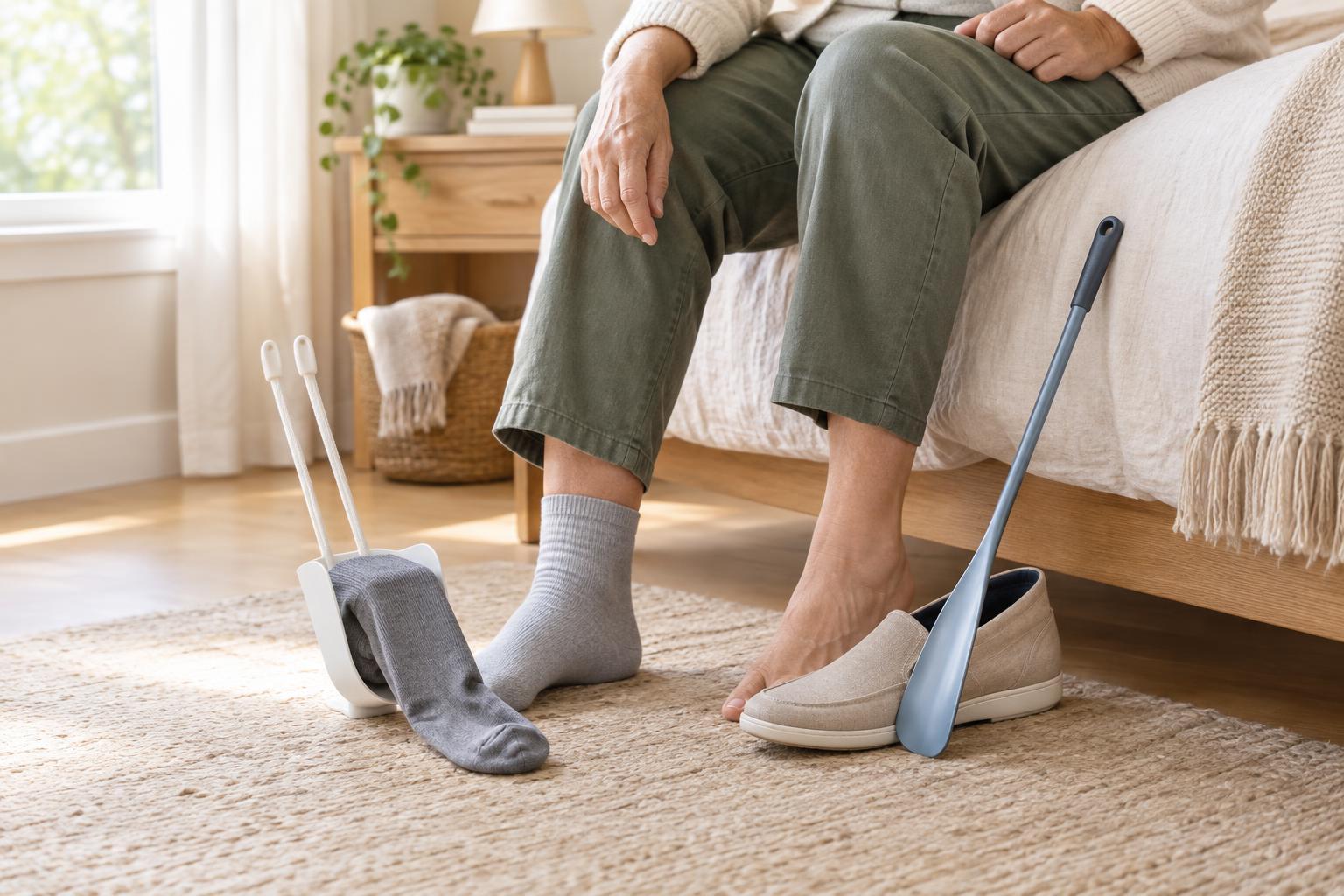
Putting on socks and putting on shoes can present different challenges. A sock aid helps guide a sock over the foot, often without requiring the person to reach all the way to their toes. A long-handled shoehorn helps guide the heel into a shoe without crushing the back of the shoe or bending down as far. Neither tool replaces the other: a shoehorn cannot pull up a sock, and a sock aid does not open a shoe.
The distinction matters when choosing a product. If socks are the difficult step but shoes go on easily, a sock aid may be the relevant tool. If the sock is manageable but the heel catches on the shoe, a shoehorn may be enough. Some people find both steps awkward and use both tools as part of the same routine. The useful question is not which product is better overall, but which part of getting dressed it is meant to help with.
How a sock aid works
A typical sock aid has a curved or flexible form that holds a sock open, plus cords or handles used to draw it toward the body. The sock is placed over the form with its opening stretched around the edges. Once the foot is positioned inside, pulling the cords draws the sock onto the foot and up toward the ankle. Designs vary: some forms are rigid, while others are softer or more flexible.
A sock aid still involves preparation. Loading a snug sock onto the form may take hand strength, coordination, or practice. Thick socks, very tight openings, and socks with unusual shapes may not sit well on every model. When comparing designs, consider whether the handles are easy to grip, whether the cord length lets the person sit comfortably, and whether the form can be loaded without a struggle. Trying the tool with the kinds of socks worn most often is more informative than judging it by appearance alone.
How a long-handled shoehorn works
A long-handled shoehorn is a smooth guide placed between the heel and the back of a shoe. Its length can reduce the need to reach toward the floor, while its curved end helps the heel slide into place. Unlike a sock aid, it does not pull fabric or fasten footwear. The shoe still needs enough opening for the foot, and any laces, straps, or closures must be managed separately.
Length, handle shape, and stiffness can affect how easy a shoehorn is to use. A longer model may be convenient from a chair, but it also needs enough room to be positioned behind the heel. A model that flexes too much for a particular shoe may be harder to control; a hard edge used with too much force can be uncomfortable or damage footwear. It helps to check how the shoehorn feels with the shoes actually worn, especially if they have a narrow opening or a firm heel counter.
Choosing around the whole dressing routine
A tool is most helpful when it fits the person’s usual sequence, clothing, and space. Think through where dressing happens: Is there a steady chair? Are socks and shoes within reach? Can the footwear be opened before the foot goes in? Small changes to the setup, such as keeping the needed items together and allowing room beside the chair for a long handle, can make either tool simpler to use.
It is also worth noticing where effort shifts rather than disappears. A sock aid can reduce reaching toward the foot but adds the step of loading the sock. A shoehorn can reduce bending but may not help if tying laces is the main difficulty. Features such as easy-to-open footwear or simpler closures may be relevant to the broader routine, though they do a different job from either tool. Choose for the step that causes trouble instead of expecting one product to solve every part of dressing.
A practical way to try them
Start with a familiar pair of socks or shoes, sit on a stable surface, and follow the product’s directions. Try one step at a time: load and use the sock aid without rushing, or position the shoehorn before sliding the heel into the shoe. If a sock bunches, a heel catches, or the tool slips, pause and adjust the setup rather than pulling harder. A tool should make the routine more manageable, not turn it into a contest of force.
After a few attempts, assess the result as well as the process. Is the sock sitting comfortably, without a folded section under the foot? Is the shoe fully on, with its back in its usual shape? Can the tool be stored and retrieved easily for the next use? These everyday details help reveal whether the design suits the task. The best choice may be a sock aid, a long-handled shoehorn, both, or neither—depending on where help is actually needed.