Start with the task, not the product
Long-handled bathing tools extend reach while washing, but they do not all solve the same problem. One person may want a gentle way to wash their back; another may find it awkward to reach their lower legs. Before choosing a tool, identify the areas it needs to reach and where it will be used: in a shower, beside a bath, or while seated. A handle that works well for the back may feel unwieldy around the feet.
Think through the motion as well as the distance. Some tools work best with broad strokes, while others can be guided into smaller areas. A longer handle is not automatically easier to use: it may take more room to turn and can make the head harder to control. If possible, check whether the handle shape feels comfortable in a wet hand and whether the head can reach its intended area without awkward twisting.
Sponges: soft contact and broad coverage
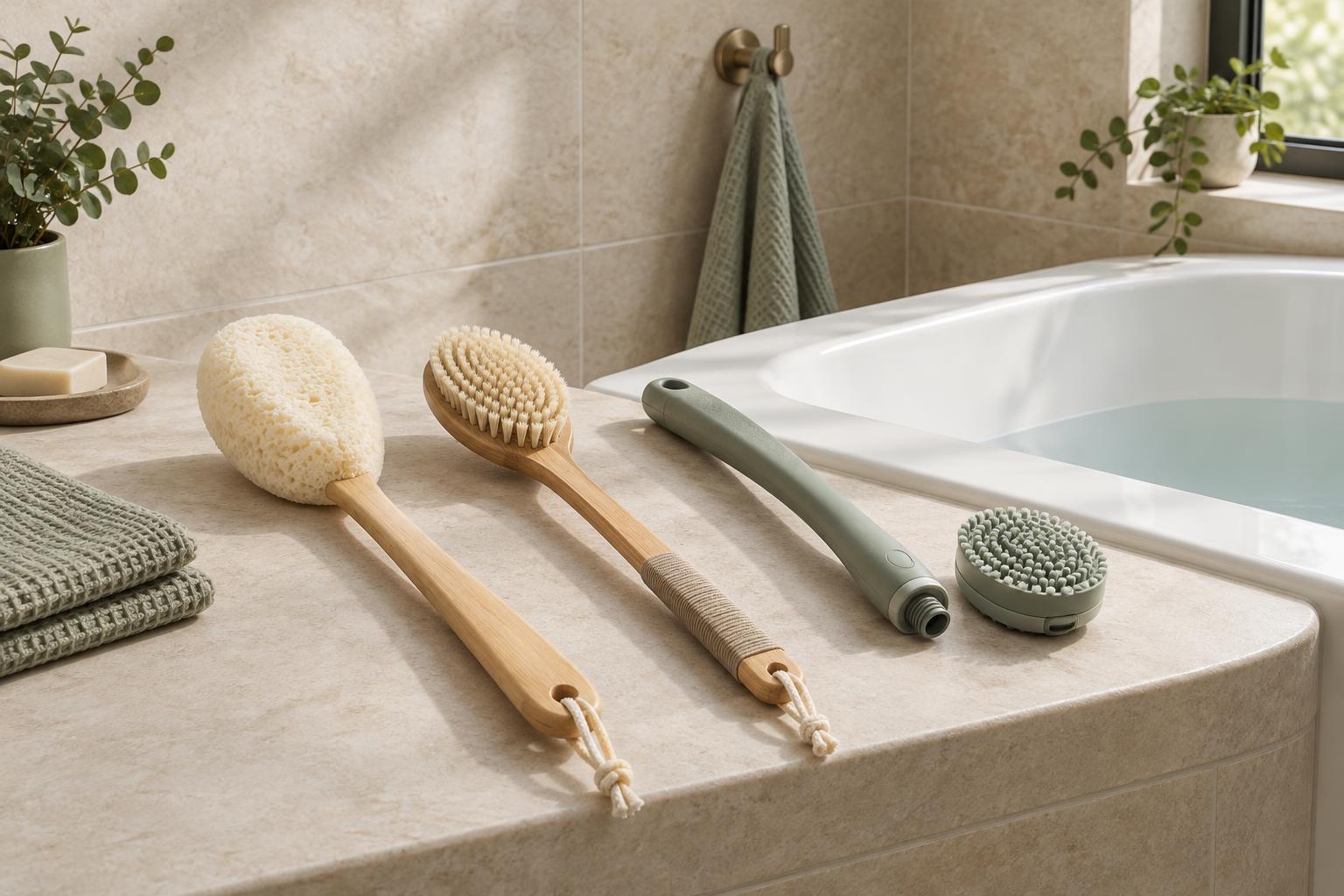
A sponge head generally offers a softer feel than a brush and can cover a relatively broad area with each pass. Its ability to hold water and cleanser may appeal to someone who wants a familiar washing motion without repeatedly reaching for more product. Sponge textures vary, though. A dense, smooth sponge can feel quite different from a loose or textured one, so the word “sponge” alone does not tell you how gentle a product will feel.
The main trade-off is care after use. A sponge may retain water, especially where it joins the handle. Look for a design that can be rinsed thoroughly and left to dry in an open spot. If the head begins to smell, shed pieces, or stay damp for long periods, it may be time to replace it. Check whether the whole tool must be replaced or whether a compatible head is available.
Brushes: structure and more precise movement
A long-handled brush usually keeps its shape as it moves across the skin. That structure can make it easier to direct than a flexible sponge, particularly when washing a smaller area. Bristles vary in length, density, and softness. A brush described as soft may still feel too firm for someone who prefers light contact, so it is sensible to start with gentle pressure rather than assuming a brush needs vigorous scrubbing.
Brushes also differ in how easily they rinse clean. Widely spaced bristles may be easier to inspect for residue, while tightly packed bristles can take more attention to rinse and dry. Check the base where the bristles meet the head, along with any seam between the head and handle. These details matter because a tool that is inconvenient to clean may be inconvenient to use regularly.
Replaceable heads: flexibility with a few checks
Some handles accept detachable sponge or brush heads. This can be useful when a head wears out before the handle does, or when different textures suit different washing tasks. It can also reduce the need to store several full-length tools. The advantage depends on whether replacement heads are easy to identify and fit securely; similar-looking attachments are not necessarily interchangeable across product lines.
Pay attention to the connection. A head should remain attached during ordinary use but come off without a struggle when it needs cleaning or replacement. Small release buttons, stiff clips, or slippery fittings may be frustrating to manage with wet hands. Before buying, consider where spare heads will be stored and whether their replacement cost makes sense compared with a simple one-piece tool.
Check grip, storage, and the bathing space
Whatever head you choose, the handle deserves equal attention. A thicker or textured grip may feel steadier to some users, while others may prefer a slimmer handle. An angled handle can change how the head meets the body; a straight one may be simpler to position and store. A hanging loop is helpful only if there is a suitable place to hang the tool where it can drain without obstructing the space.
Test the intended movement without rushing, especially in a compact shower or around a bath edge. Keep the floor clear of tools and packaging, and avoid using the handle as a support for balance; a bathing tool is not designed to bear body weight. The most useful choice is usually the one that provides comfortable reach, feels manageable when wet, and is simple enough to rinse, dry, and put away after each use.