What these two aids do
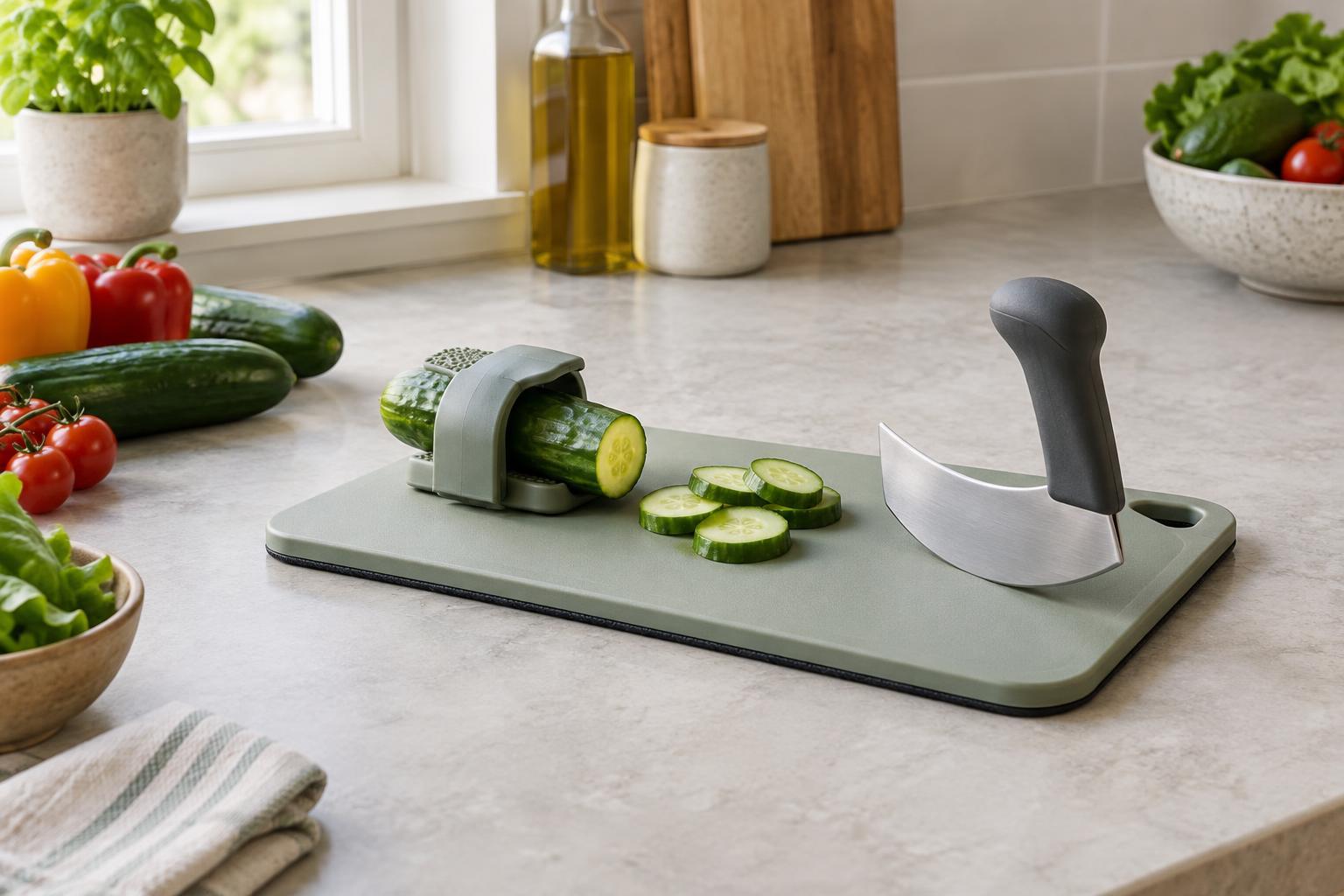
Chopping an ingredient usually involves two jobs at once: keeping the food steady and moving a knife through it. A cutting board with a food holder and a rocker knife address those jobs separately. Either tool can be used on its own, and they do not necessarily work well together. The most useful choice depends on the food being prepared, the available counter space and how the person prefers to work.
A board with a food holder may have a raised edge, a corner stop, an adjustable clamp or short prongs that grip an ingredient. These features can reduce the need to hold food directly beside a blade. Some boards also have non-slip feet or a lip that rests against the counter’s edge. A rocker knife has a curved blade designed to cut with a rocking motion rather than a long forward stroke. Its handle may sit above the blade, giving the user a different place to grip than a conventional knife.
Start with the board and the work surface
Board stability matters before any cutting begins. Set a board on a clean, level counter and check whether it moves when pressed from different directions. A non-slip base may help, but its grip can vary with the counter material and whether either surface is wet. A board that hooks over a counter edge needs an edge it fits securely; it may not suit a rounded or unusually thick worktop.
Consider which foods the holder can actually secure. A corner stop might steady a loaf or a firm vegetable but do little for small, round ingredients. A clamp may accommodate different sizes, yet its mechanism should be easy to adjust and clean. Prongs can hold some foods firmly, but their points need careful handling during washing and storage. If the holder leaves too little clear cutting area, the board may feel cramped even when it grips well.
It can help to rehearse the layout before picking up a knife. Place an uncut ingredient in the holder, then check whether there is room for the blade, the hand on the handle and a container for prepared pieces. Position the board so reaching across the cutting path is unnecessary. If the counter is cluttered or the board shifts, changing the setup is more useful than trying to compensate while cutting.
Check whether a rocker knife suits the task
Rocker knives vary in blade length, curve, weight and handle shape. A short blade may be convenient for smaller portions, while a longer one may cover more of a broad ingredient. The handle should feel secure without requiring an awkward wrist position. Some designs have one central handle; others have two. Neither arrangement is automatically better, so it is worth considering where both hands will be during use.
The rocking motion works best when the board provides enough flat space for the blade to travel. A food holder must not obstruct that path. Very tall ingredients, dense foods or pieces that roll away may be difficult to cut this way, even if a holder is present. As with any sharp knife, keep fingers clear of the blade and avoid using extra force to make an unstable setup work. A different tool or a different way of preparing the ingredient may be the more practical option.
Choose for everyday use, including cleanup
Before buying, think through a few familiar preparation tasks rather than judging a product by its list of features. Can the board hold the foods used most often? Is there enough room for the knife to move? Can the board be lifted, carried and stored comfortably? If possible, try the handle and adjustment mechanisms without food first. A tool that is straightforward to position and put away is more likely to earn a place in a routine.
Cleaning is part of that routine. Food can collect around clamps, prongs, seams and the joint between a blade and its handle. Check the maker’s cleaning instructions, particularly before putting any part in a dishwasher. Wash and dry surfaces that touch food after use, and keep raw ingredients separate from foods that are ready to eat. Store the rocker knife so its edge is protected and cannot be reached accidentally.
These aids are not a single solution for every kitchen task. Their value lies in making a specific preparation step more manageable within a well-arranged workspace. A stable board, an ingredient that is properly held and a knife that has a clear path are more important than having the most features.