Start with the print you need to read
A magnifier that works well for a book may be awkward for a label on a curved bottle. Before choosing one, think about where the small print appears: on flat paper, food packaging, a device, or an item you need to hold in one hand. Also consider whether you usually read a single word, a short instruction, or several paragraphs. The task matters as much as the lens.
More magnification is not always easier to use. As letters appear larger, the area visible through the lens may become smaller. You may have to move the magnifier more often to follow a line, and a slight shift can make the text harder to find again. A useful choice makes the print readable while leaving enough of the surrounding words in view to navigate comfortably.
When a handheld magnifier fits
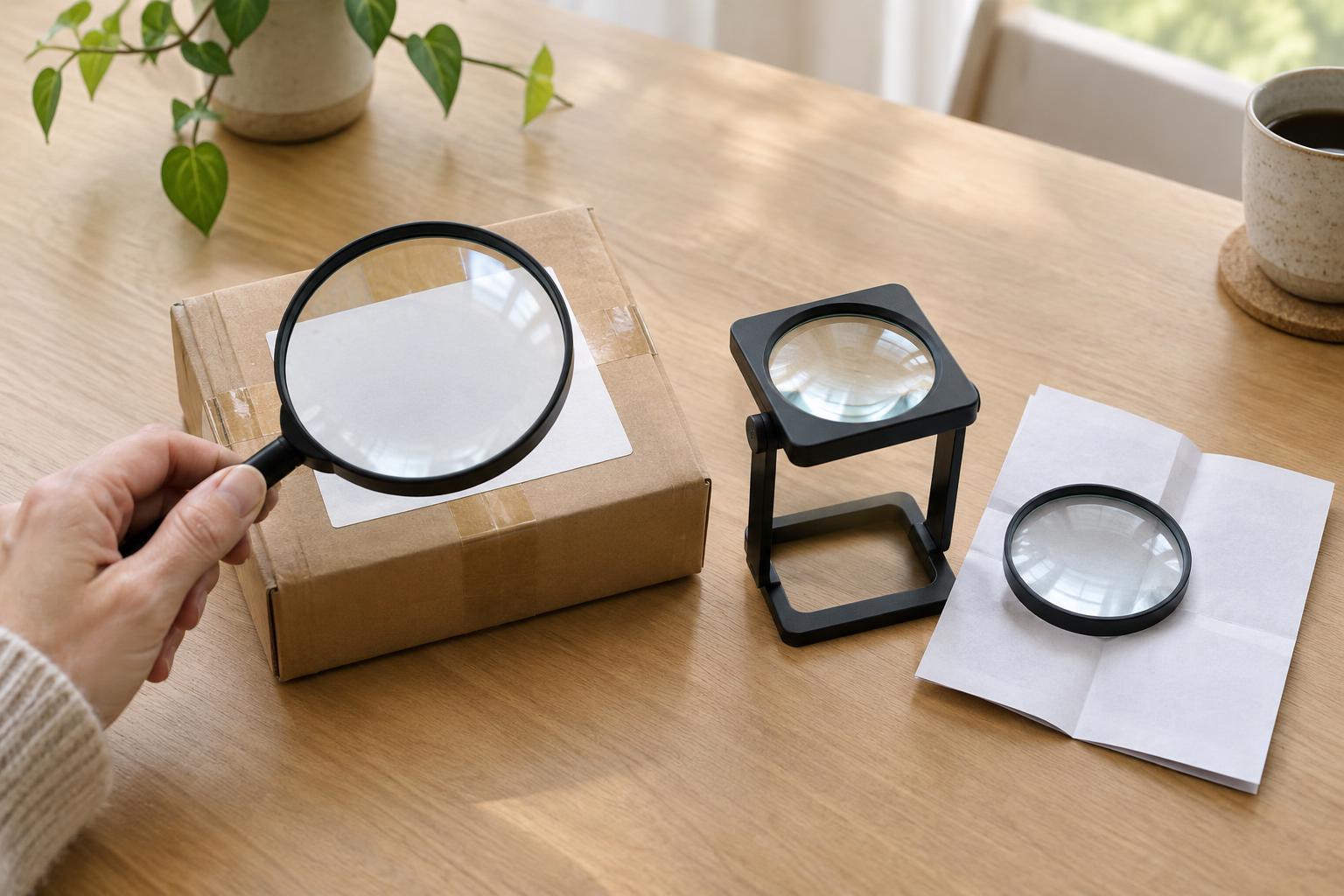
A handheld magnifier is easy to pick up and aim. It can be convenient for checking a price tag, reading a control panel, or looking at a label while standing. Because it is not tied to a tabletop, it can follow print on objects that are difficult to place beneath a stand. Models vary in lens size, handle shape, weight, and whether they include a light.
The trade-off is that you must position the lens and keep it steady. The clearest view may require a particular distance between the lens, the print, and your eyes. Holding that position while moving across several lines can be tiring, especially if your other hand is holding the object. For brief checks, this may be manageable; for longer passages, it may interrupt the flow of reading.
When a stand magnifier fits
A stand magnifier has a base or supports that rest on the reading surface. That structure keeps the lens at a more consistent distance from flat print, so you do not have to hold it in place. It may be helpful for reading a recipe card, printed instructions, or a letter at a table. Some designs can be slid along a line of text; others are better for viewing a small area at a time.
The base also creates limits. A stand magnifier may not sit securely on an uneven package or reach print near the edge of an object. You still need to move either the tool or the material as you read. Check that there is enough room beneath the lens for the item you intend to use it with, and that you can see the full width of a typical line without awkward repositioning.
Compare comfort and lighting together
A clear lens is only part of a comfortable setup. Glare from glossy packaging can obscure letters, while a shadow from your hand or the magnifier may darken them. Try changing the angle of the item or using an even light from the side before deciding that you need a stronger lens. If you are considering a lighted magnifier, check how its light falls on both matte paper and reflective labels.
Notice the physical effort involved, too. A larger handheld lens may show more print but feel heavy after a few minutes. A stand may reduce the need to hold a lens steady but require space on a table. Handles, switches, and bases should be easy for you to grip, place, and move. A tool that gives a sharp view only in an uncomfortable position is unlikely to be the most useful everyday choice.
Try a realistic reading task before choosing
If possible, test magnifiers with examples of the print you encounter most often rather than a single sample card. Try a short label, a longer paragraph, and any curved or glossy packaging that routinely causes trouble. See how easily you can locate the first word, follow a line, and find the next one. Repeat the test in the sort of lighting you normally use.
You do not have to solve every task with one magnifier. A portable handheld option may suit occasional checks away from a desk, while a stand may be more comfortable for flat pages at home. Larger-print versions of instructions, a well-placed lamp, or a device that enlarges text on a screen may also be useful alternatives for some materials. The best choice is the one that makes your common tasks easier without adding too much setup or strain.