Start with the task, not the fastener
An adaptive closure is most useful when it makes a particular garment easier to put on, adjust, or take off. A closure that works well on a jacket may be awkward on a shirt cuff. Before comparing products, notice what makes the current garment difficult: lining up two edges, gripping a small piece, pressing firmly, reaching behind the body, or keeping fabric steady while fastening it.
Also consider where and when the garment is used. Someone may manage a closure easily while seated at home but find it harder when dressing in a hurry or wearing gloves. The feel of the closure against the skin, how securely it holds during movement, and whether it can be opened without pulling on the whole garment all matter. No single fastener is the best choice for every person or every item of clothing.
Hook-and-loop: forgiving alignment, with some trade-offs
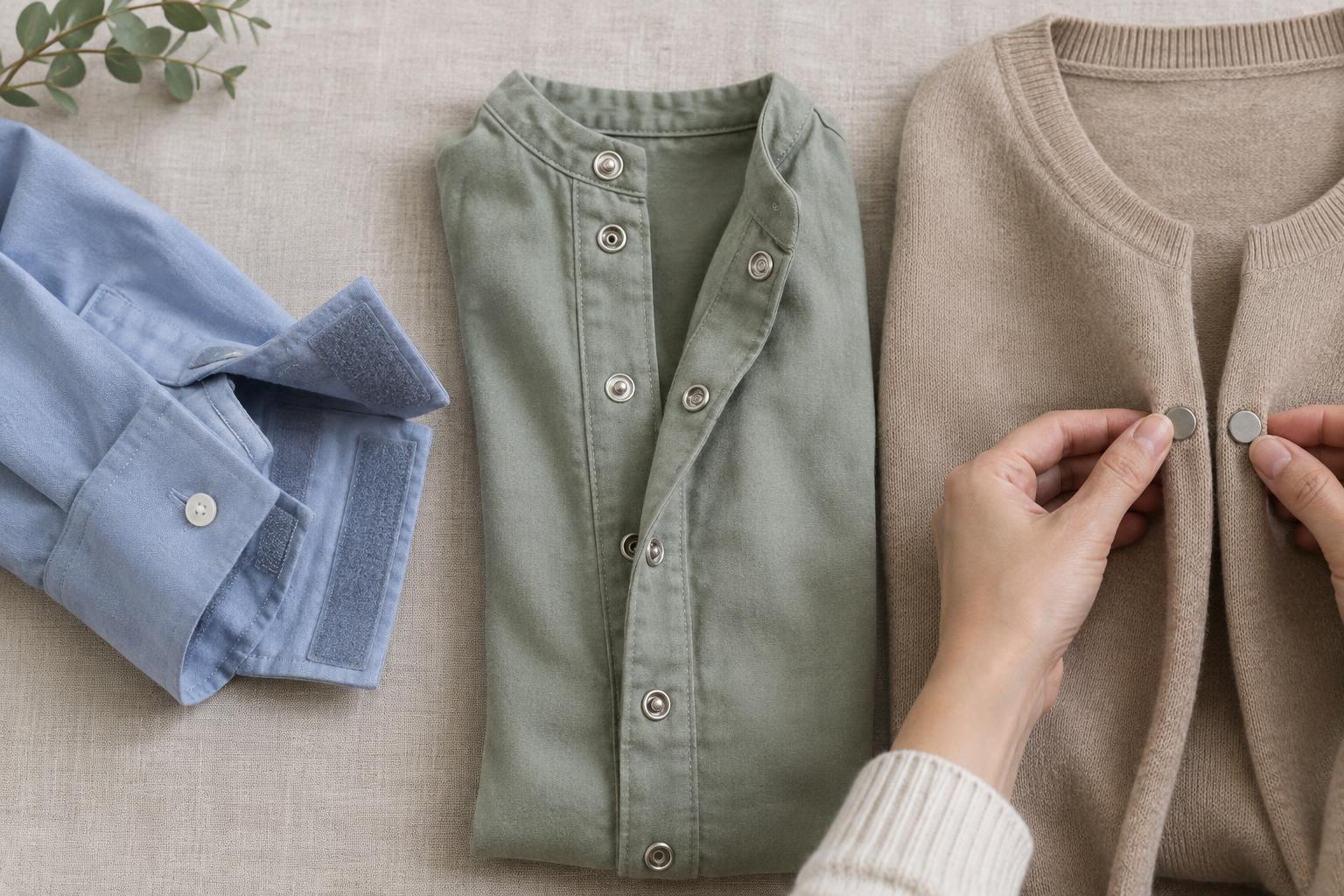
Hook-and-loop closures use two fabric surfaces that grip when pressed together and separate when pulled apart. Because the surfaces can meet across a fairly wide area, they usually require less precise alignment than a small button or snap. A larger tab can also provide something substantial to hold. This makes hook-and-loop worth considering for shoes, cuffs, waist adjustments, and openings that need frequent access.
The trade-offs are mostly about texture and upkeep. The hook side can feel scratchy if it touches skin, catch on other fabrics in the wash, or collect lint that reduces its grip. Opening it makes a distinct sound, which may be unwelcome in quiet settings. On a garment, look at how the strip is positioned when both open and closed: an exposed edge can be more bothersome than a neatly covered one. Closing the strips before laundering and following the garment’s care label can help limit snags.
Snaps: compact, but pressure and placement matter
Snaps join two small parts with a press and release when pulled apart. They have a low-profile appearance and do not have the fabric-catching surface of hook-and-loop. Some garments use several snaps along an opening, allowing the wearer to fasten only the sections needed. Larger snaps or fabric pull tabs may be easier to handle than tiny, tightly set ones.
Unlike a broad strip of hook-and-loop, each snap needs its two parts lined up. Closing it may take thumb pressure, and opening it may require a firm pull. These demands vary by snap design and by the stiffness of the surrounding fabric. If trying a garment in person, test the snaps in the position in which they will actually be used. A snap that feels simple at chest height may be harder to operate at a cuff or behind the body. Check, too, whether pulling a snap open strains the fabric or nearby seams.
Magnetic fasteners: easy to bring together, with specific cautions
Magnetic fasteners are designed to attract and meet when their parts come close together. They can reduce the need to line up a small closure exactly, particularly when used beneath a decorative button or flap. Their performance still depends on the garment: heavy fabric, an awkward angle, or tension across an opening may make fastening or keeping it closed more difficult. Try the full movement of dressing and undressing rather than judging only how the magnets meet in your hands.
Magnets deserve an additional safety check. Magnetic closures may be unsuitable for someone with an implanted medical device or other equipment that could be affected by magnets; consult the device manufacturer’s guidance before choosing them. Small magnets or detachable fastener parts can also be hazardous if swallowed, so inspect closures for damage and keep loose parts away from children. Follow the garment’s care instructions, including any directions about laundering or drying magnetic components.
Choose by testing the whole garment
A useful comparison involves more than fastening and unfastening once. Try the closure with the garment on, using the hands and posture normally used for dressing. Notice whether one hand can steady the fabric while the other works, whether the closure stays shut during ordinary movement, and whether it is easy to find by touch. If another person helps with dressing, their ability to see and reach the closure matters as well.
Finally, consider daily maintenance and personal preference. A quiet snap may suit one setting; an easy-to-locate hook-and-loop tab may suit another. A magnetic closure may simplify alignment but require a safety check that the other options do not. Choosing a closure is often a matter of balancing effort, comfort, security, and care requirements—not finding a universal winner.